Thursday, 12 February 2015

As British as you can get


The British are known for their devotion to certain things they love. Walking on the streets of London I made a list about some of those tremendously British things. 

1. The red telephone box, regardless the spread of the cell phones, is still decorating the UK streets. I could not actually picture London without the cute red boxes, which nowadays serve mostly photographic purposes.   


2. The identical houses with the red bricks, that are stuck to each other remind me vividly the magic residence of Harry Potter's godfather at the Number 12 Grimmauld Place. This house was invisible to the neighbourhood residents and had the magical ability to appear only to the selected wizard ones, pushing its way between the numbers 11 and 13. The muggle owners of the following houses put their own personal details. For instance, they give different colours to the doors, or they place discreet flower pots on the threshold. 


3. I wonder which is the amount of tea, that is anually consumed in the UK. I dare to guess pretty big. The traditional English tea is served with milk and a cube of sugar. Some tea shops offer afternoon tea which is pretty impressive next to the tiered cake stand. That three floor stand carries sandwiches, scones and cakes. While in Britain we payed a visit to the cute Camellia Tea house and tasted an amazing caramel salted cake and a red velvet. The cookies and cupcakes are also a British favourite habit, which makes a perfect match with the tea.

Red velvet cake

Ben's Cookies
Hummingbird Cupcakes
4. The Pub is another British love. Every Thursday the schedule includes drinks at the pub right after work. There are many kinds of Pubs. First comes the traditional one, that is usually located in a neighbourhood, and despite the bad microwaved food has became a venue. The decoration is rather minimal and darts are hanging on the walls. It is more than likely that a pool is on display and pool tournaments are taking place between friends and neighbours. The aroma of the place brings inevitably coherence to Beer. This kind of Pub mainly has male frequenters. On the other hand, there is another species of Pub a lot more posh and refined. It offers a larger range of traditional english  delicacies and I would describe it more like a Bar- Restaurant, except its architecture and the fact that it has a funny name as all Pubs do. The Queen's Head, the Idle Cook, Bucket of Blood, the Swan, the Mad Dog, Dirty Dick's and the list goes on and on. A useful tip is that most of the times there is no service at the tables, but you should order at the bar.


5. Fish and Chips has worthily earned a place on my list. It seems that when it comes to that chapter me and my sister were incredibly lucky, or the opposite (it depends on the point of view). She happened to live right above the most renowned Fish and Chip's of London: Mike's fish bar. In Mike's portion the chips are forming a pile and are wrapped on a greaseproof paper. Even for me it is almost impossible to manage one portion on my own. The cod is covered by a thin crust of breadcrumbs and it tastes literally nothing like the captain Iglo's fish sticks.
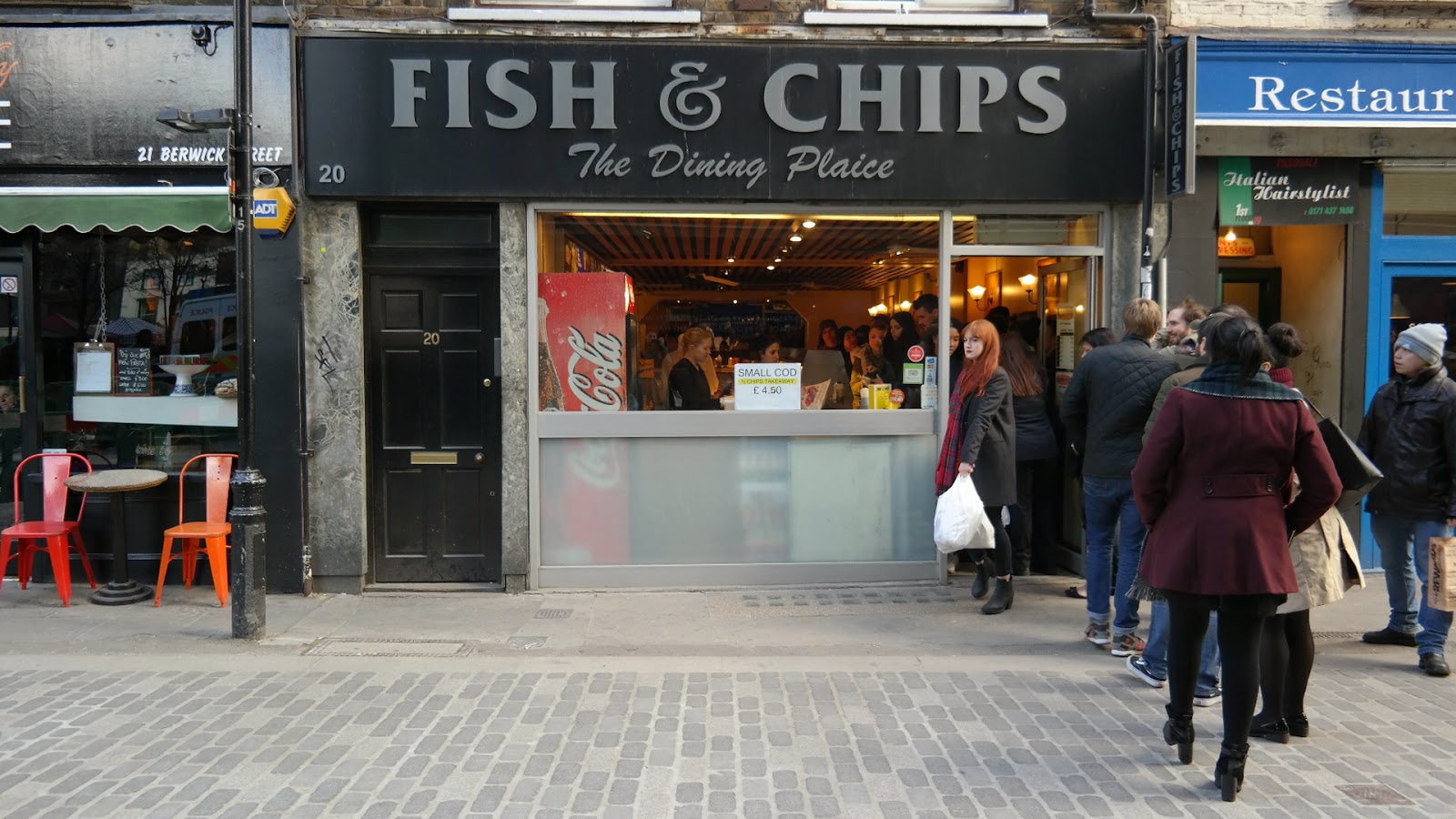


It is honestly hard to put a full stop, as the list could be much more extended than this. The double decker buses, the english breakfast, the driving at the left (aka wrong) side of the road, the strange habit of giving brands different names ( Opel-Vauxhall, Axe-Lynx), the bizarre beach houses, the stand up comedians, would all worth to mention. But then again I would spoil entirely the mystery of England. 

Read More »

Friday, 6 February 2015

Mind the gap


In the UK the security issues are first priority. Especially in the underground, that is used everyday by thousands of people, the precaution measures are particularly enhanced in a unique british way. "Mind the gap" is the perfect slogan. Not too big, not too short. It even sounds melodic. Nowadays it's been stolen by most of the undergrounds of the world, that failed to find something as catchy as the ultimate "mind the gap".


In Paddington station, there is a mysterious magic line that leads your steps to Hammersmith and City line. The contribution of the yellow and pink line should not be underestimated. When off the Bakerloo line, following the signs, you find yourself in a massive train station. Right at the point when you feel that you are complitely lost and you turn your head to the ground hopelessly, the yellow and pink line appears as a lifesaver on the floor and brings your smile back. The line does not let you alone for a minute. It keeps lightening your way even on the stairs. I wondered whether they were influenced by Harry Potter's Marauder's map for that descreet but powerfull line.


With no second thought, the human size stickers, that depict the mark of bodies on the ground, are influenced by the old police tecnique in case of a murder. What is special about them, is the message which accompanies them. Always in a british humor atmosphere, they urge the passengers to not forget their manners.


London underground is seeking new modern ways to stay in fashion, although the oldest tube in the world. To be honest there is nothing more fashionable than the classic London underground . Or maybe there is an at least one competent opponent: the Paris Metropolitain


Read More »

Thursday, 5 February 2015

The red bricks

After I said farewell to the number one suspect in the UK, I caught a couch to Baker street. The identical british houses with the red bricks seem kind of melancholic on a cold Wednesday night. I couldn't help but wondering ,who inhabits them. Are they happy, ambitious, in love, British, migrant, young, old? What is their daily routine. Do they maybe have a horse to take care of every evening? Do they read a book or watch teli?

An hour and twenty minutes later, the driver announces our arrival at the Baker Street. I take my luggages and wonder how I will meet my always late sister without a charged phone. "Pret a manger" gives me the answer. I rush inside and order a cup of tea. The melancholy gave its place to excitement. This city is not only red bricks. It is bustling with people. I looked quickly around me. The musterious people, i was so curious about acouple of minutes before, were sitting next to me.  Talking on the phone, reading a book, socialize after work.


My running-late sister met me at the coffeeshop and we decided to take our chances to the tiny and popular Burger shop: the Patty and Bun. We walked through Baker Str to Marylebone and saw some more houses with red bricks.  This time I knew that in the past a very bright British personality lived on the number 221B of that street. One hotel was named after him : Sherlock Holmes

The shop was packed, as expected. A tall skinny guy showed us the way to the outdoors waiting bench. Fortunately my new coat looks and feels like a mattress and did not let the freezing cold to reach me. The waiting lasted for approximately twenty minutes. The burger did reward us. It tasted like real meat, something  a little rare in London. 


Read More »

Sunday, 28 September 2014

West African Fashion


The perspective of African Fashion I had before I ever saw an African woman in a traditional clothing, was a total distortion of reality. In my mind animal print, wooden accessories, white light shirts and khaki shorts constituted the African style. In Ghana though you will barely see someone dressed in these, while the white clothes are easily getting stained by the mud.
     
From the very first time I saw a woman in African dress out of my trotro window, I was drawn by the lively colours and designs. I soon learnt that those dresses were made from scratch according to the personal preference of the owner. Then it dawned on me: I would make my own authentic Ghanian fashion collection! On this article, I share some tips for the fashion lovers.. 

  1. Vlisco ad

    Step one: you select the cloth. It is produced by ghanian factories and is wax printed. You can find it literally in every corner. Women are selling it on the streets or in shops. At the malls it is posible to find more refined fabric by famous brands such as Vlisco, which costs three times more than the common one. The price range varies based on the quality of the fabric and the saling spot. A usual price is 7 to 10 ghanian cedis ( 1,74- 2,48 euros) per yard. The total fabric comes in 6 yards and the most luxurious ones, which are destined for special occasions, are not sold in pieces. But in most cases you can select the size of the garment. 3 yards are adequate to make a short dress or a skirt with a top.                                                                                                  
    Vlisco ad 1

    Vlisco ad 2

    Vlisco ad 4
      
    Vlisco ad 5

    Vlisco ad 6
    The predominant colours are vivid green, red, orange, fuchsia, blue, yellow. Leaves, hearts, seeds, african signs, and adsent designs are printed on the fabrics. A friend of mine, who is keen on the darker colours was observing the side of a store where the dark brown, black and purple fabrics were stored. A nice lady approached us and  said spontaneously: " we only wear these colours in funerals". The lady was not exaggerating at all. I honestly saw dark dressed people only in funerals.                                                                   
    One of my favourite print is called "Angelina" and is very popular in Ghana. Another is named "Eye of the tiger". The fabric feels rough at first but it softens after multiple washes. The traditional Ghanian textile, Kente is actually silk and cotton fabric made of interwoven cloth strips and requires a lot of work. In the rest Westafrican countries, I was informed that they have similar prints, but the texture of the fabrics is a little different.       
    kente cloth
    by kaylarjones
    Recently, I read an interesting article that describes the history of the African fabrics and reveals the Dutch origin of the wax prints: “African Fabrics”: The History of Dutch Wax Prints.                                                                                                                                           My fabric paradise was located a quarter away from our interns house, in Madina Market. Much as I was apalled by the first central Market, I fell in love with this one. Frequently after school I was heading to Madina Market in order to get lost in the colourful streets with the peculiar objects. The fabrics were always my personal favorite. I was often being told off by my Botswana friend because I spent all of my money in cloth. I kept replying grinning that "the way I see it is not a waste of money rather an investment". Once I was so concentrated on my shopping that I forgot that it would get dark soon. That night I saw my Market more beautiful than ever, calm and easy in the dim light of the lanterns...                                                        


  2. Step two: you have to decide on the exact design. The web gives you the opportunity to go through countless african fashion choices until you feel dizzy. Most of my decisions are attributed to pinterest . Other relevant sites, like africa fashionweek ny, are very enlightening too. The tailors also have big posters on the wall whith many different designs, which are a little too traditional for me. The following pictures depict some of my favorite african outfits, which I tried to imitate.                                                                  


  3. Step three: you need to find a good tailor. Just like the fabric selling stores, the taylor shops are numerous in the streets. I advice you to ask your local friends for their recommendation on the issue. The tailor will take your measurements and create the clothing of your choice. That way you will add a unique piece in your garderobe! I was so excited about this freedom.  Personaly, I had a failure before I found the tailor of my life, Isaac. Firstly, a lady came at school and we assigned her to sew three different cloths, which eventualy were neither delivered on time nor fitting to us.
The second tailor, whom the other teachers at school introduced to me, was Isaac. His workshop is in the porch of his house, near the school. However, it is hidden in a mystic neighbourhood, in whose paths I was lost more than once. His expertise are in my opinion the dresses, while he can make almost anything if you give presice description. Our collaboration resulted in four skirts, five dresses, a pair of shorts and a top. He is taciturn and very collaborative. If the skirt was tighter or the dress longer than I wanted, he'd amend it at the same minute, not looking annoyed at the slightest. The payment of the tailor depends again on his popularity, the difficulty of the design and the quantity of the cloths you are making. The more the cheaper. Indicatively, most of my dresses cost from 20-30 ghanian cedis (=4,97- 7,45 euros) to sew.
          
After the final stage the African clothes are ready to wear! I did not mind so much whether a white girl in african traditional fabric was a weird spectacle, or not. I wore my first dress as soon as I got home from the tailor. Apparently I did look weird but the Ghanians in the streets gave me looks of approval, laughing benevolently at the same time. When I showed up at school in an African dress I received a rain of compliments : "Lilly, I like your dress"! Frankly, there is no better fashion critic for me than my five year old students. 
          
My africanfashion-mania was obvious even at my last minute in Ghana, as I was runnig at the tailor to receive my final pieces on my way to Kokota airport.

                                                                                                                                                                                          Photo by Daisy


My african wear collection


"Fashions fade, style is eternal."
— Yves Saint-Laurent

Read More »

Saturday, 6 September 2014

Good reads about Africa

Personally, I love books. I love to enter a bookstore and head to the department that is hiding all the wisdom of the knowledge area that I am currently exploring. I love to open my new books for the first time and slightly fold the rigid pages. I love to be carried away by the unexplored worlds, which are inaugurated via my books.
   
For that reason, once I booked my tickets to Ghana, I was convinced that a good book would become my best friend to my new adventure. The lady in a big Athenian bookstore, when I let her know what I am searching for, pointed at the shelf with the English books. She recommended a small book with the devastating title "Things fall apart", by the most popular Nigerian author, Chinua Achebe. She further explained to me that this novel is being taught in the Greek University for "English Literature studies"  as a representative sample of African writting.


I will not argue that this read is a little depressing, but at the same time somehow intriguing. It reveals the story of Okonkwo, a hard-working, well-respected man in a village of Igbo tribe. The story is set in the pre-colonial Nigeria in the 1890s and includes many interesting information about  local tradition, supersttitions, religion and every day life of the time. The most unique element of this story is that it unfolds the transition from the African religions to the Chiristianity and also the first traces of the British colonialism
    
My second book, concerning Africa appeared in front of me without prior research. Just out of the blue. I was in a Greek Island (Ikaria), shortly before I travel to Africa, when I noticed, right outside my room, a corner with some old and dusty books. One was particularly thick. I went closer and I read its title in big bold Letters: "Africa: Altered States, Ordinary Miracles" , by Richard Dowden. 


Of course, I grabbed it instantly and read its last page. It is written by a British journalist, who has expertised in African issues. Through the book the reader can follow Dowden in his real-life journeys across Africa. The chapters are divided according to the African countries, which he has visited in different points of his life holding another role each time. Firstly, he traveled in Uganda as a volunteer in a school, exactly what I was going to do. The most captivating characteristic of the book is that the author shares his sincere feelings, concerns and fears about Africa with his readers.  He also instills his hard earned wisdom, to his readers. For me, the book was enlightning and soothing, for I felt that my concerns were not unfounded, but someone else, fourty years before, had simillar concerns and wrote them down for me to read.

Last but definately not least, comes my favourite book of all. I also run into it out of luck, while I was strolling around in a big bookstore in the Mall of Athens. It bears the title "Cloth Girl". The author of this amazing book, Mairilyn Heward Mills, is a Swiss-Ghanian, who was raised in Accra. 


The story is set in colonial Gold Coast ( Accra before independence) and was inspired by the grandmother of Heward Mills. The protagonist is Matilda, a fifteen year old poor girl, whose outstanding beauty defined her fate. She was selected by a rich Ghanian lawyer as his second wife at the young age of fifteen. Her dreams to acquire education were shuttered and the family making and maintainig it became her only concern. Despite her age, Matilda served her duties the best way she could. In the novel, many different characters make their appearance. An employee of the British Government, who adores Ghana and his British wife, who on the contrary withers in Africa. The respected Ghanian lawyer, who had studied in Cambridge and adopted many of western habits and manners. His first wife who, although Ghanian, is acting and dressed like British. The family of Matilda, who is thrilled about the new affinity with the lawyer.
 
The reader indulges the vivid and accurate description of Ghanian scenery, that is not much altered until nowadays. In the course of the story, significant political events, right before the delibaration are also mentioned, contributing in the realistic essence of the novel. This book not only lightened many obscure aspects of Ghanian way of thinking, but also boosted my admiration for the Ghanian family bonds, respect, commitment. 


    “People had warned me about the culture shock of going to Africa. Nothing prepared me for the culture shock of coming the other way. No matter how much I talked no-one understood what I was saying.”  Richard Dowden.


Read More »