At dinner time little groups headed to different directions in quest of food. I and two of my friends decided to ask recomendations from the locals. Two little girls waived at us. We asked them where we could find some food and they urged us to follow them. Soon our company became bigger. More kids joined us looking happy with such unusual guests. They assured us that our friends went to a nearby hotel to dine. I thought how strange, but at the same time sensible, it was that five people passed before us and got noticed right away by the curious kids. They looked also very confident that we were all friends. Our little guides escorted us gladly to the end of the village, where a senior instructed them strictly to return back. So they did unwillingly. At the hotel indeed we found our friends.
Later on the night our plans included a beachparty. A very kind local put up a fire for us, which, irrespective of our hard efforts, did not last long. It seemed that some of us did not feel like sleeping. The youngest girl from our company, eighteen years old, was sitting on the sand gazing at the mighty ocean. She happened to be teaching at the same school as me. I approached her and commenced the most sincere and deep conversation I had in Ghana. That night two girls, a Greek and a Brazilian one, shared the same fears, the same agony and the same unanswered questions. How essential is our help after all? Will our presence at school make any difference to the kids' life? What will happen after we leave? Are we going to continue our lives as if those two months never happened, while at the same time our little students will keep on struggling for a better life? No need to even utter our thoughts after a while. We sighed under the strong moonlight and looked at the endless blackness of the ocean.
We were traveling all night. This time the trip had been very popular and no seat was vacant. In the morning we arrived at our beautiful destination: Beyin Beach. The scenery reminded vividly documentary scenes. The sea shore seemed endless. Exceptionally high palm trees were laying on the beach. Beach houses made by wood and palm trees' branches were standing on poles above the ground. Even the toilet was bizarly marvelous, while an open window was right ahead of it offering unrestricted view to the ocean.
We were all expecting to visit the unique village of Nzulezu(=surface water). As its name states a village on the water. The canoe station was at walking distance from the huts. We went aboard the big, but rather short canoe, and indulged the beautiful trip. At the beginning the passage was short and could not fit two canoes at the same time. Later it became wider and the nature thicker. In the end a big lake appeared- Lake Tadane. An incident brought be violently back to reality. A little local boy, who was traveling with us, sunk his bottle into the still lake water and took a big sip out of it. Instantly I remembered a similar scene from documentaryinSiera Leone, which had made me crying.
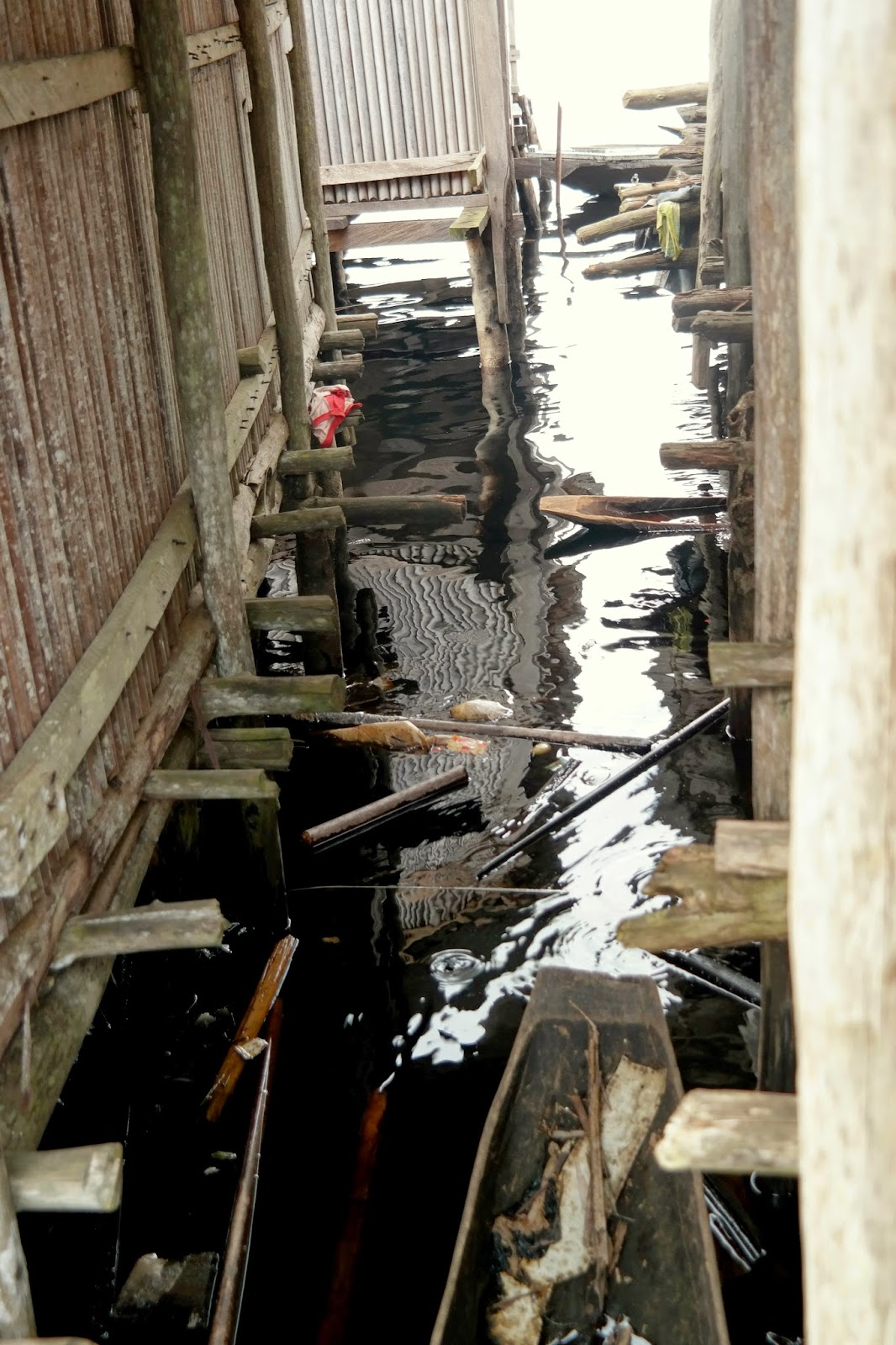
After a while there it was. Nzulezu, a village on stilts nominated for Unesco World Heritage Site, was spreading in front of us. Photography fee paid and our tour among people's houses began. The locals seemed to be familiar with the tourists, for sculpted miniature canoes were on sale in the little shops and receipts were offered to the tourists. Other than that life on the village seemed to be usual. Women were preparing family lunch and doing the laundry while kids were playing around. The sole path led us to the school, which for some of our team had a sentimental meaning. A few years ago they had realized a social project, through the same student NGO, concerning the school library. When we were on the narrow corridor in front of the school, observing the outstanding spectacle of houses made of rafia on the water, a cracking noise was followed by a feeling of descending. Thankfully the corridor moved only by an inch or so and did not drop us into the unwelcoming lake waters.
The School
We were seated at an open air venue next to the school and informed about the history of the village. At the end, we were offered the floor to make questions. Some wondered about rubbish collection, electricity, rain issues, burial. There seems to be an "extension" of the village on shore,with which Nzolezu is connected and supplies it with the necessities. Moreover we learnt that "Thursday" is a sacred day at Nzulezo: no fishing is permitted and no tourists are allowed at the village. Snails are revered by the inhabitants, since it is believed that the early settlers or the ancestors were led there by a snail. Another interesting fact concerns the "judiciary system". The elders of the village and the chief, hence the most respected personalities, form a regulatory body and decide upon criminal offences, apart from felonies. Leaving the village on the water behind, I and my Greek friend started singing Greek songs from classic black and white movies. Maybe this was the first time that the lake creatures have heard such peculiar tunes!
Our exciting day had started by hiking in Afadjato Mountain, continued with swimming in Tagbo Waterfalls and would end with a beach party in Maranatha beach, or at least that was the plan. After the Waterfalls we headed to Ada Foah. Fromthe narrations of Eduardo, a Brazilian intern, this place would be one of the most beatiful sceneries of Ghana. Every Saturday night the beach is transformed into an outdoor beach club, that promises a lot of fun. Everything was set. We had had contacted the owner of the resort and made reservations for the beach huts. A boat would pick us up from the one side of the lake and deliver us to the other, where the party would take place.
We were all anticipating to test and improve our dancing skills once again. But the way was long, the weather rainy and oops we also got lost. Consequently we arrived at the meeting point a little.. later than agreed. Something around one o clock at night. Needless to say that the party was over and no canoe was waiting for us any more. There was only one solution: to spend the night in our beloved trotro. That would be a bit of a mission, because this time every seat of the trotro was occupied. Thus there was no free space to stretch ones tired bodies. But it was not only us in the trotro. Mouldy clothes and sneaky tropical mosquitos were also accompanying us. The excess amount of the antimosquito spray did not cease their bloodthirsty attacks. Some of us managed to sleep, like the Chinese for example. A couple others stayed outside the trotro for the night. A French and a Brazilian guy were holding their laughter back while watching "Ice Age". I would switch between the three options, sleeping, "Ice Age", hanging out.
The fullness of the trotro
Next day morning
Finally, the time had come to visit our "Ithaca". It definately worths waiting for. The sun had just come out, the water was serene and the view hard to describe with words. High palm trees, painted in blue, pink and yellow, were poping up from everywhere. The doors of the beach huts were painted in a flag's colours (no matter how meticulously I searched, I did not find one in blue and white stripes). The traces of the previous night party were still tangible. At first we laid in the sunbeds in order to regain our horizontal shape. The lake was so calm that even Mario's (medical student's) warnings about protozoa infection hazard, did not stop me from diving.
Comfortable sunbeds
Beach huts for rent
A little piece of heaven
The transportation means of Maranatha
Later on, I decided to follow the bravest to the other side for exploration and swiming in the sea. Just a few steps away from the resort's area, the rubbish were forming small hills. The sea was just how I remembered it, wild and wavy. Some peculiar, almost transparent, white crabs were running around in great numbers.
A little further from the "touristic" area is laying a small village. The houses are built on the sand and made by palm tree fronds, weaved skillfully. The sun was burning and I was clever enough to not wear my flip flops. Thankfully Mario lent me his. Apart from rubbish hills, I noticed some other hills by shellfish, that in Greece are considered a luxurious delicacy. It seems though that shellfish and tourism has not influenced much the village, whose inhabitants face multiple problems. At some point we encountered a new school, in a basic structure. It does give a spark of hope for the future.
Ghana, Greece, Brazil, France
The way to the village
shellfish
Testing my balance skills
Travelers playing soccer with local boys
"The Tribe" Documentary by volunteers in Maranatha: 1, 2, 3, 4, 5, 6
In our second trip we would explore Volta region, on the east part of Ghana, close to neighbouring Togo.The trotropicked us up in the midst of the night. The ride was so crazy that I preferred to sleep than to be awake and consequently aware of the extreme speed, overruning and turbulence on a bumpy dark road. Things went as planned until an extended horn noise and some blindingly powerful lights woke me up. Although we were in the middle of nowhere, a huge lorry was speeding right towards us. I shut my eyes, convinced that I would soon see my life in photo frames. A laughter of relief coming from Mario interrupted my thoughts and assured me I was still on earth. He said "I was just thinking from which window I should escape".
A few hours later we arrived at our accomodation to rest till the morning. Next day, still shaking from last night's drive, we were warmly wellcomed by the owners of the hotel. Milo, eggs, yums were served in the restaurant as a breakfast in order to load up our batteries for the rest of the day.
Next up was hiking on Mountain Afadjato. A silent teenage girl with short hair, some of which was grey, sold us boiled eggs and water. The way to the top was steep and seemed pretty long under the hot sun. Finally, we reached the peak of the mountain, sweaty and proud. A group of excited students surrounded us, the obrunis, to take a picture together as if we were any Hollywood actors. A sign congratulated us on our acchievement "Wao! You have made it! You are on top of the highest mount in Ghana! Enjoy the panoramic view!" . But the sign was soon refuted by the sight of one clearly higher mount right next to it.
As it often happens in a tropical climate, the sun was succeeded by thick clouds, which resulted in no time in heavy rain. And there we were: On the top of the highest (or not) mountain of Ghana, exposed to tropical rain. The struggle of the Chinese to maintain their dryness subsided. Soon we were all soaking wet but totally happy. The way back was transformed into a muddy slide. I took off my non-suitable allstars and kept sliding barefoot. Some travellers were not discouraged by the rain and mud, and kept ascending the mountain. By the time I returned at the starting point I literally looked and felt like a dirty pig. Luckily our next stop would be Wli Falls, where we could have a nice swim.
In a little while we were at the entrance of the Waterfalls. We paid the fee and walked through the rainforest escorted by a guide, who was holding a vast umbrella. He was very helpful and obviously expected a tip. As we were approaching the highest Waterfalls of Ghana, the sound of the falling water pounding on the lake became more and more loud. The moment I saw this amazing spectacle, I had no second thoughts about swimming. Everybody was in the water, knowing how to swim or not. The sand was moving at some places and the depth of the lake variated. The Waterfall was so mesmerizing that we moved as close as possible to it, holding each other and creating a human chain. The water was gently "whipping" our backs, like a good massage. The feeling of freedom was unique.
It was Sunday morning. I woke up early in order to indulge my breakfast in my Oasis.I picked up my Africa book and sat at a table close to the beach. I ordered the popular Milochocolatebeverage, which came to pieces. Hot water, milk, sugar cubes and Milo- chocolate powder. The kind waitor helped me to cook my drink.
In a while the rest of the company woke up and we moved to the beach. An interesting everyday scene was unfolding before our eyes. A dozen of big fishermen were dragging the nets out of the sea. They were also singing a motivational fishing song in an African language. The nets were spread far into the sea and judging from the hard effort depicted in the fishermen's faces, fishing was not an easy case. The majority of the fishes was gathered at the end of the nets. Nontheless some small fishes and sea snakes were accidentally caught on the way. They were collected carefully in plastic buckets by naked experienced kids. A man approached them and bargained on the price of the catch with the liliputian fishermen.
When the entire net was laying successfully on the shore the song seazed. Turmoil prevailed among the group. They were argueing upon the share of the catch. The amount of the fish each would take home, was depending primarily on the personal contribution. Some were accused of inadequate input in the fishing process, while others underlined their essential help.
A girl, selling sachets of water, passed slowly in front of us. Her eyes were modestly looking at our direction. On her attempt to bring the heavy platter down, half of the sachets fell clumsily on the ground. She picks it up hastily, while shame was conceivable in her moves. Another woman was selling fried bread and cut it wide open to fill it with peanut butter. When the fishermen had vanished from our eyesight and everyone had taken a generous breakfast was time to head to theCape Coast Castle (http://www.ghanamuseums.org/forts/cape-coast-castle.php).
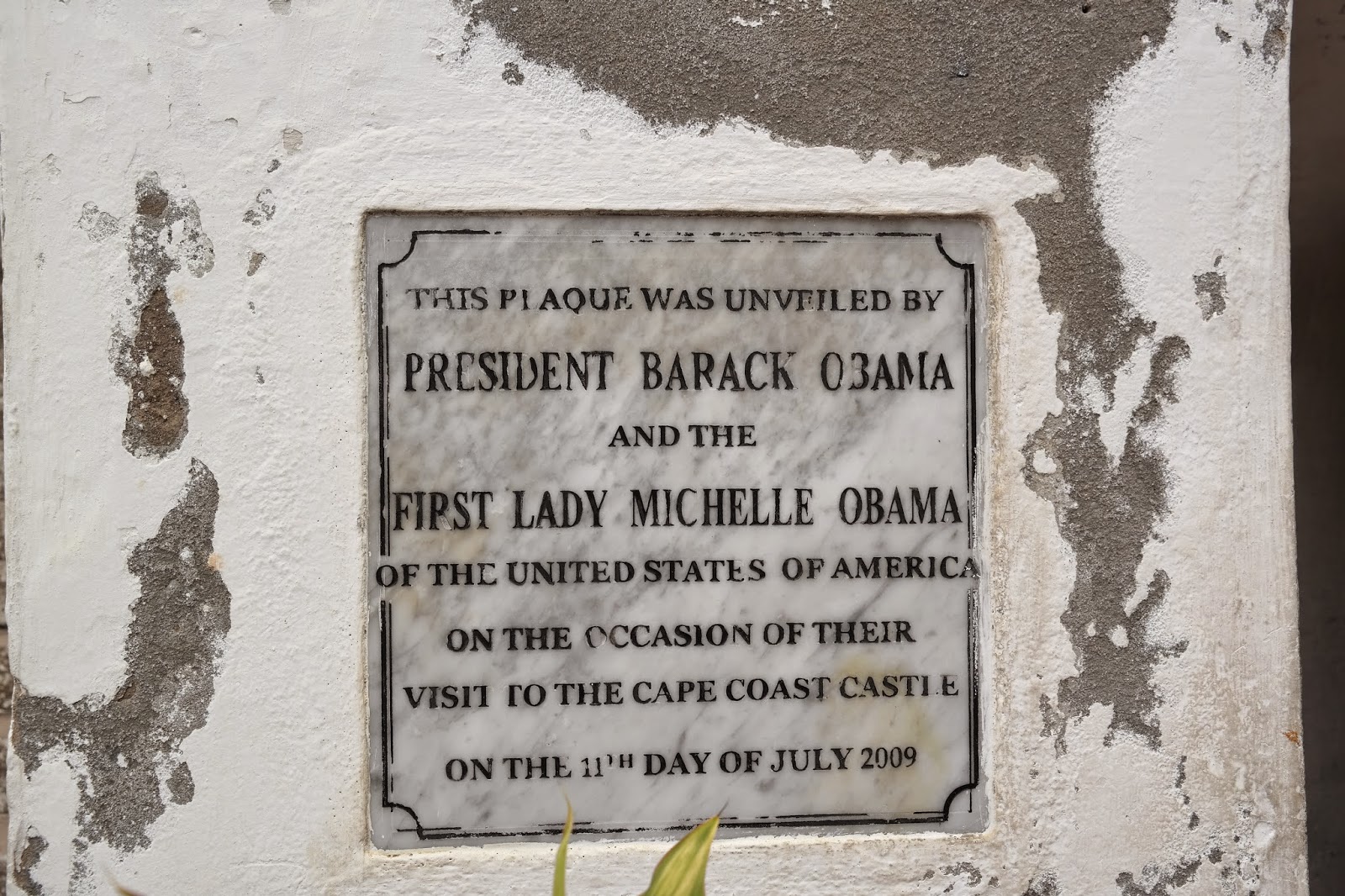
Driven by ignorance, a day before I had asked my Ghanian friend and guide, if Cape Coast Castle is an exciting place. He answered with a mysterious tone that I will figure out myself. So I did. Excitement was not the feeling that Cape Coast Castle caused to me, rather bewilderment, shame and repugnance. The place, where we were standing, was actually one of the thirty "slave castles", where the slaves were held before shiped once and for all to the "New World", America. A spirited guide narrated the dreadfull history of the Castle. It had changed several hands in the past. Portuguese, Swedes, Danes, Dutch, French had passed from this strategic venue for trade, before the British established their power. For 150 years, the atrocious exploitation of human life had been the most prolific source of wealth for the Europeans and Americans. Cape Coast castle is a painful reminder of this inhuman human activity.
The captives generated from many neighbouring african countries and were forced to come to Ghana by foot. The captives, who had survived the unfavourable trip were to be held underground until they were picked, sold and shiped away. Sometimes this process lasted even months Our first stop was the main concentration room for the men slaves. It had a tiny hole high on the wall and the atmosphere was sultry. It was imposible to imagine that a thousand men used to be held in that room. Scientific findings confirmed that the ground was covered by layers of human waste, blood and urine.
Close to this room the Europeans had built a church in order to not miss the chance to pray to their God. Ha! How ironic!
The next room was the cell where the people who dared to escape were to find excruciating death. The room had no windows at all and the walls were extremely thick. No food, no air, no light was accesible to the sentenced. Scratches on the walls and the floor gave away the pointless struggle of the slaves for survival. It felt as if the walls screamed from the horror of the untold human tragedies.
The women were held separately. Some of them were destined to become sex slaves. The children, who were born via rapes, were given European names and received western education. This way a new caste arose.
The "Gate of no return" was leading straight to the atlantic ocean. Its name was attributed to the fact that any slave who passed it would never view Africa again. The guide assured us bitterly that we will return.
Then we moved to the first floor, which belonged to the commander of the Castle. The contrast was unbearable. The space was huge, with vast windows, which allowed plenty of air and light to go through the rooms. A question was swirling in my mind: How could he ever sleep in this luxurious apartment while at the same time over a thousand people were dealing with diseases, hunger, fear, solitude, many of whom leaving their last breaths just a floor below?